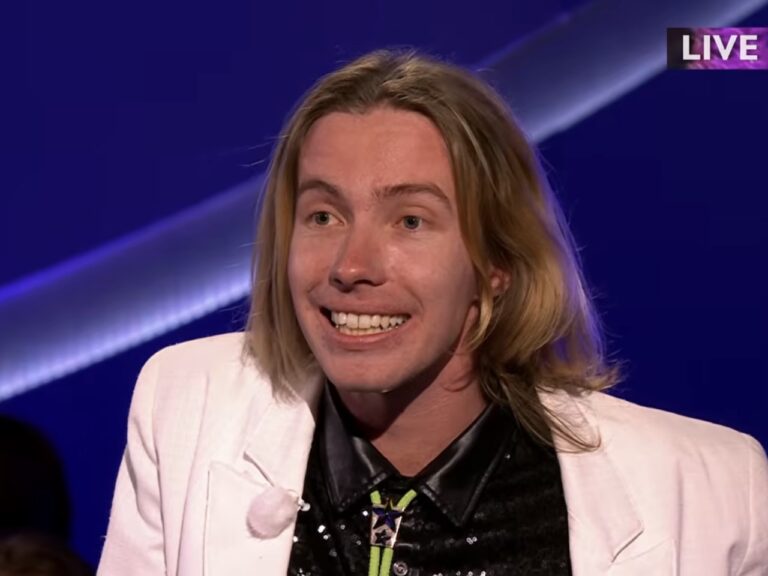
Gabriel Clark for The Night Larry Kramer Kissed Me / Dawn Kilner
Following his acclaimed performance in last year’s ensemble comedy Jock Night, Hollyoaks alum Gabriel Clark is returning to the stage in a very different queer-themed play: The Night Larry Kramer Kissed Me. Written by David Drake and first staged in 1992, this powerful one-person piece explores how a politically charged piece of theatre – Kramer’s seminal drama about the HIV/AIDS epidemic, The Normal Heart – can change someone’s life and entire worldview.
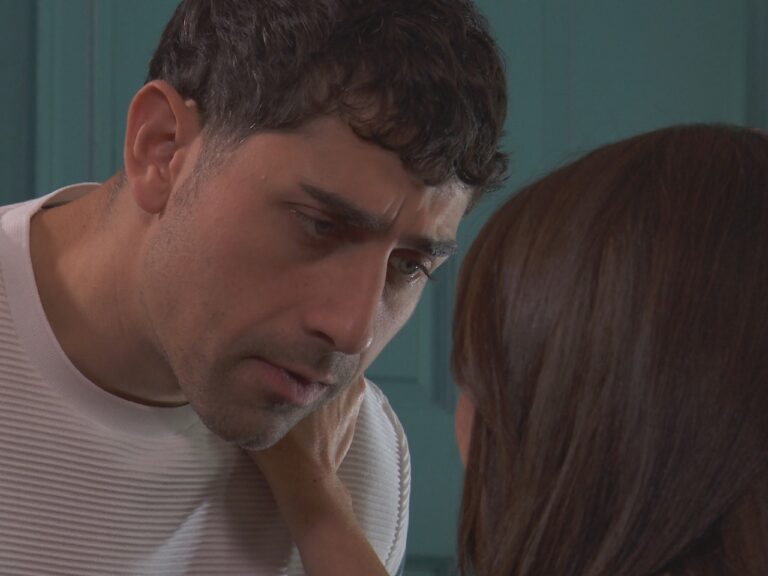
Having completed the play’s Manchester run, Clark and director Adam Zane are now bringing the production to London’s Seven Dials Playhouse. Here, Clark talks about the play’s continued relevance as well as his upcoming role in Tip Toe, the new LGBTQ+themed drama from Russell T Davies. He also shares some thoughts on what his Hollyoaks character Ollie Morgan might be doing now, more than two years after we last saw him.
Hi Gabriel! So, how would you describe the premise of The Night Larry Kramer Kissed Me?
“It’s the story of a gay man who was born in 1963, who begins to realise his sexuality through the amazing musicals he sees on stage in the 1970s – shows like A Chorus Line and 42nd Street. After seeing A Chorus Line, he goes on a date with an older guy called Tim, but gets caught by his parents. He’s thrown out of the family home and decides to move to New York because that’s where all the plays he loves are set.
“One night in 1985, he goes to see The Normal Heart by Larry Kramer because it stars Brad Davis, who was a big heartthrob at the time, and it totally changes his life and perspective: it makes him into an activist. So it’s essentially a play about how art inspires activism and activism inspires art. It’s very experimental, quite poetic and incredibly powerful. When I first read it, I was like, ‘This is going to be a great challenge because it’s just me on stage, but I absolutely have to do it.'”
David Drake wrote the play back in 1992, and it’s obviously set a little way before that. What do you think today’s LGBTQ+ community can learn from it?
“A very large part of this play is exploring how a series of moments can lead to a movement. There’s a line in the play where the performer says: ‘We’re smashing down invisible, fearful, hateful walls again.’ And for me, that’s the relevance of this play today. I feel that we’re at another point in time where a series of moments will lead to a movement. I mean, even last week, the Trump administration took down the Pride flag outside Stonewall [the US national LGBTQ+ monument in New York].
“At the same time, we’ve got Farage and the far right in the UK starting to peddle incredibly homophobic and transphobic language. Transphobia especially is on the rise, and we have a duty as an LGBTQ+ community to stand up together and fight back. Because when they come for one, they come for all of us. Rights, though hard won, can be taken away very, very easily. So I feel like this play almost acts as a bit of a handbook and a guide as to how one becomes radicalised into activism. It shows how anger is the most useful tool, if channelled correctly, for creating political change.”
I do think plays like this can highlight the fact that there’s still a lot to fight for. For example, the government first pledged to ban conversion therapyin 2018 under Theresa May, but this still hasn’t been pushed through by four successive Prime Ministers.
“We’re seen as a political football – an issue like conversion therapy is something [politicians] can use to get the ‘queer vote’, the ‘pink vote’. We’ve got a Labour government now – a very centrist Labour government anyway – and the ban still hasn’t happened. It’s not a difficult thing to do – to ban the state-sanctioned torture of queer people, because frankly that’s what conversion therapy is.
“Even the right of gay men to donate blood is still not equal to straight people. I find it really bizarre that my brother, who’s straight, could sleep with 50 people in a week, then go and donate blood with no questions asked. Whereas a gay man [who isn’t in a monogamous relationship of three months or longer] still isn’t allowed to donate blood, despite the fact that everyone is tested for HIV when they give blood anyway. It makes no sense.”
We’ll see you back on TV later this year in Tip Toe, Russell T Davies’ new LGBTQ+-themed drama coming to Channel 4. What can you tell us about it?
“Well, I can’t say anything really, but I can say it’s one of the best experiences of my working life. My role within it is part of a big ensemble of LGBTQ+ actors, and we were filming on Canal Street with extras who are genuine Canal Street regulars, so it just felt so special. Obviously, the scripts are unbelievable – Russell is a genius who’s got such an incredible way of tapping into humanity. Every single character, even if they just have one line, brings a whole world with them. It’s a show that’s had so much joy and love poured into it, but it’s also telling a story that I think is very vital right now. I think it will be a big wake-up call to a lot of people. It’s a celebration of who we are, but equally, it’s a call to action that we sorely need.”
How would you describe its relationship to Russell’s previous LGBTQ+themed dramas set in Manchester: Queer as Folk and Cucumber/Banana/Tofu?
“I’d be interested to hear what Russell would say about this, because I feel like [Tip Toe] explores his relationship with Canal Street. It’s asking really interesting questions about the fact that places [like Canal Street] have become sort of democratised and accessible to everyone, but also a bit of a tourist attraction. One of my favourite bits of stage direction in the script says something like ‘there’s a large number of hen parties in the bar’.
“He’s asking really profound questions about the importance of queer spaces today – how I feel like we’re going to need them more and more – but also exploring the relationship that young people have with them. Because we’ve not been under the same threat [as previous generations], we might go out in [other parts of Manchester like] the Northern Quarter or Spinningfields, and maybe neglect Canal Street a bit. Like all Russell’s shows set in Manchester, Canal Street feels like a character, so I think the sort of commonality between them is how that character of Canal Street has evolved.”
Finally, it’s been over two years since we last saw Ollie, your Hollyoakscharacter, who swapped Cheshire for Canada. What do you hope he’s doing now?
“Oh, Ollie! He went through a lot, so I’d just like him to be happy, really. His dad found him, then started to lose him very quickly [after being diagnosed with dementia], so he didn’t get much security there. What would he be doing now? I just hope he’s met someone who’s allowed him to feel settled – someone who isn’t a conspiracy theorist or a mild terrorist!”
The Night Larry Kramer Kissed Meis at London’s Seven Dials Playhouseuntil March 1.